
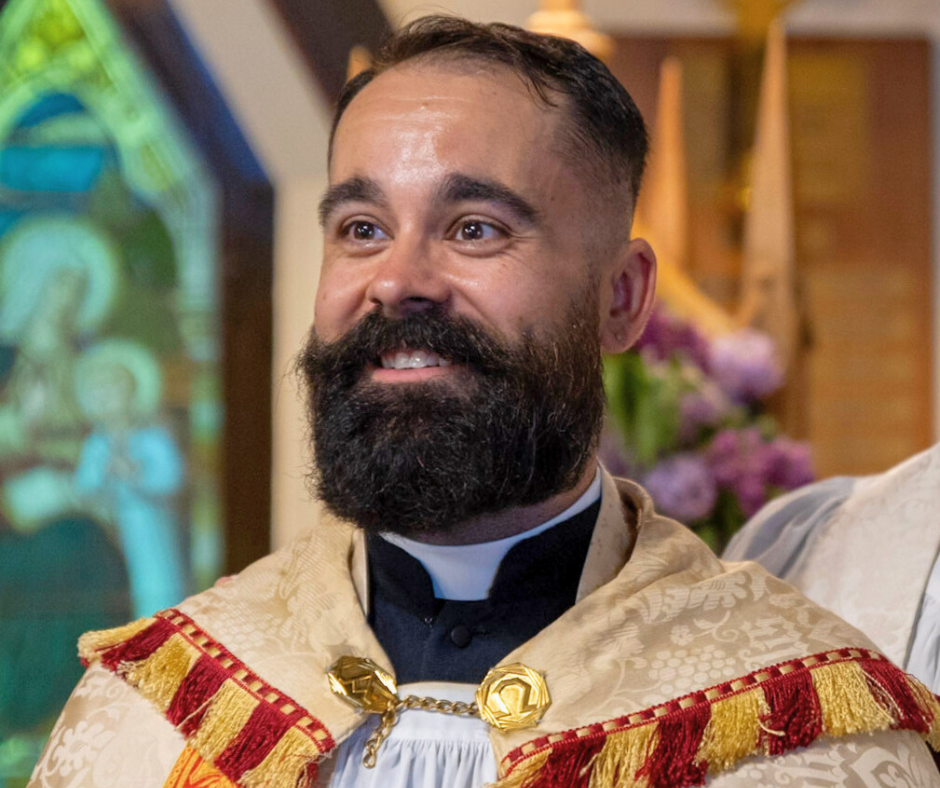
Serving the Church in a rural, multi-parish context requires resilience, creativity, and a deep commitment to people spread across great distances. In the Eastern Townships, one priest ministers eight parishes, navigating long drives, shifting church landscapes, and the emotional weight of change—all while discovering new signs of hope and renewal. In this interview, he reflects candidly on the realities of rural ministry, the challenges and joys of walking with congregations in transition, and the ways tradition and innovation can coexist in the life of the Church.
What are the biggest challenges of serving multiple rural parishes?
The biggest challenge is the geography. From end to end, my region spans almost 100 km. Having multiple Sunday services in different locations often makes it feel like I’m always on the run; there’s never enough time to spend with the first congregation as I dash out the door to the next service. It isn’t easy to connect with people when you’re always on the move.
Another personal challenge is that it’s all too easy to get despondent sometimes. The Anglican landscape of the Eastern Townships has changed significantly in the five years that I’ve been here: I’ve been part of a dozen church closures and building sales. That’s quite something to go through within your first years of ordained ministry! It has been a genuine privilege to walk alongside these congregations in this time of transition, but it is hard and emotional work.
Are there assumptions people make about rural or multi-parish ministry that you’d like to challenge?
A lot of people seem to think that I have an idyllic, easy life in the country. Yet, multiple parishes come with multiple challenges — multiple building problems, multiple personalities, multiple administrations. I have no secretaries or administrative assistants. I spend a lot of time in my car, regularly driving hundreds of kilometres each week. I am the only full-time priest across eight parishes. And, even in those places where we have sold a church building, I still get called upon to do pastoral care or funerals — the building might be gone, but the ministry continues. Life in the country is wonderful, but the work is hard!
How do you manage fatigue and avoid burnout?
I try to make time for things other than the Church, and take full advantage of all that country life has to offer. I love to cross-country ski and hike, I split my own firewood, bake sourdough bread, keep chickens and have a big vegetable garden: I planted 250 garlic bulbs this year! I go to the gym 3-4x a week and I have my rambunctious, but loveable dog, Roxy.
Does anyone help you in your ministry?
I am the only full-time priest, but I am not alone. I am very grateful for the support of two retired priests (Archdeacons Linda Borden Taylor and Tim Smart), as well as two deacons (Randy Gates and Judy Ball) who assist in the area. I have a lay reader who serves in one of the parishes. I am also thankful for the important support of the lay leadership teams that help me in my ministry.
Can you share an example of an initiative that’s made a real difference in the community?
One of my parishes, St. James the Apostle, has a Youth Council. It’s not a youth group or Sunday school, but a group dedicated to fundraising for initiatives that support young people and families in our region. Since 2023, the Youth Council has donated almost $9000.00 to things like Breakfast Programs in elementary schools, which ensure that young students start their day with full stomachs and alert minds.
It is so rewarding to be able to empower and equip the younger generation for leadership, and it is having a direct impact on our parish attendance: we are getting record attendance at Christmas and Easter services, higher numbers than we’ve seen in the past 40 years! The average Sunday attendance is also slowly growing. People want to be part of a good thing.
How do you balance honouring tradition with adapting to change?
I love tradition! I would consider myself a traditional priest: we even had incense at one of my churches on Christmas Eve. But, within that tradition, I strive to make radical space for the newcomer, and especially the next generation.
At St. James the Apostle, we have our Youth Council. Our treasurer is 25 years old and just completed a masters degree in accounting; one of our wardens is in her 30’s and brings her two young daughters with her on Sundays.
Instead of tucking children away in another room, we’ve made a corner for them directly in the church. Don’t get me wrong, I think Christian formation at all ages is important, but this is a way of showing families that they are welcome, that kids belong in church — that kids belong in the liturgy.
What has rural ministry taught you that you might not have learnt elsewhere?
It really feels like in only five years, I’ve had an entire career’s worth of administrative experience: I’ve been involved in a dozen property transitions, I’ve worked with real estate agents, surveyors, lawyers, municipalities, and notaries. I’ve been involved in major construction projects, worked with contractors, spearheaded fundraising campaigns, and applied for grants. I don’t know how many other priests have that level of experience so early on in their careers. I’ve gained some serious business experience!
Do you have any goals for the future?
I recently applied to Carleton University’s program for Philanthropy and Non-Profit Leadership. The structures that have sustained the Church for decades are no longer working: we need to pivot, we need to adapt. My learning goals for the program are to build greater confidence in envisioning and implementing strategic planning, and better ease in navigating the challenges of constrained budgets and limited resources. I want to be more capable of leadership in the Church of tomorrow.